
Wedge-Welding Experience That Still Matters.
Novaweld.com has been associated with industrial wedge welding for decades—from early BPR systems to the genuinely handheld GT-100 and integrated GT equipment engineered around the application.

Base Pressure Roller — BPR — Wedge Welding
GT wedge welders were developed around Base Pressure Roller welding. BPR changes the relationship between the heated wedge, pressure roller, material, and supporting surface. The result can be configured as a true handheld welder or engineered into a purpose-built integrated machine.
The GT-100 represents the simplest complete handheld BPR configuration. GT-200 and other integrated GT systems apply the same pressure concept in equipment built around material handling, seam geometry, workflow, and the operating environment.
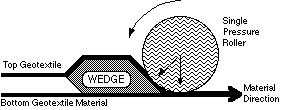
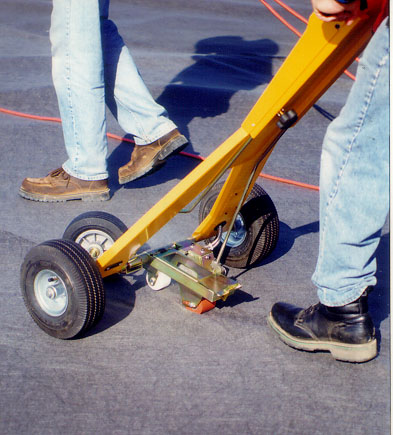
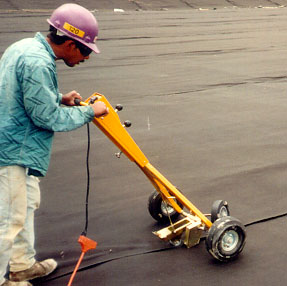
GT-500 → GT-100 → GT-200
The important development story is not a change from one welding technology to another. GT-500, GT-100, and GT-200 all used BPR. What changed was the machine built around that principle.
GT-500 / Rover
A heavier, substantially more complicated automatic portable BPR system. It demonstrated what BPR could accomplish in a self-propelled machine.
GT-100
The BPR concept simplified into a genuinely handheld wedge welder—less machinery, direct operator control, and broad production, fabrication, field, repair, and detail capability.
GT-200
An integrated BPR system originally developed around compatible nonwoven textile and geotextile applications. Walk-behind is one implementation; the broader concept is application-specific integration.
GT-100 — Genuinely Handheld
The GT-100 was engineered specifically for handheld operation—not by shrinking a powered traveling machine into a portable package. The operator carries and guides the complete wedge-and-pressure system along the seam.
- No powered drive train, gears, belts, chains, or motorized feed rollers are required for welding motion.
- No drive-system jams. Because the GT-100 does not use a powered feed or drive system for welding motion, there is no downtime for clearing drive/feed jams.
- Used for production, fabrication, field work, repair, maintenance, patching, straps, reinforcements, edge welding, and detailing.
- The GT-100 can also weld dissimilar flexible materials together when both materials can be heat welded.
- Different material weights and thicknesses can be addressed through application-specific process settings.

When the Application Calls for More Than Handheld
BPR is not limited to a handheld machine. Integrated GT systems can incorporate material handling, seam guidance, machine travel, controls, tooling, and other application-specific requirements directly into the equipment.
GT-200 and application-specific GT systems
The GT-200 was developed for compatible nonwoven textile applications and specialized seams. Newer integrated GT systems can be engineered around other materials and production requirements where a purpose-built BPR configuration is the better answer.
Current integrated GT engineering includes application-specific material handling, specialized seam requirements, and configurations for materials including compatible nonwovens, HDPE geomembranes, vinyls, and other heavier heat-weldable plastics.
Far Beyond a Single “Geo” Market
Early Novaweld applications were strongly associated with geosynthetics. Today GT wedge-welding applications are much broader: industrial fabrics, heavy vinyls, compatible plastics, nonwoven textiles, membranes, fabrication, field work, repair, patching, straps, reinforcements, and specialized integrated systems.


Production suitability depends on the complete material composition and layer structure, seam design, process settings, support, and required performance.
BPR or OPR?
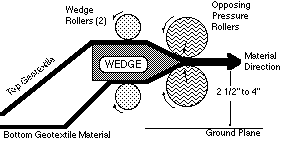
The two fundamental pressure arrangements solve the same basic welding task differently. BPR works against a supporting base or surface; OPR consolidates the seam between opposing pressure rollers. The right architecture depends on how the material, seam, and machine need to move.
Equipment or Technical Information?
Looking for equipment?
For current GT-100 and integrated GT wedge welders, application engineering, quotations, parts, service, or support, go to Novaseal.com.
Visit Novaseal®Researching wedge welding?
For BPR, conventional opposing-roller methods, materials, weldability, process selection, and application references, go to WedgeWelding.com.
Visit WedgeWelding.com